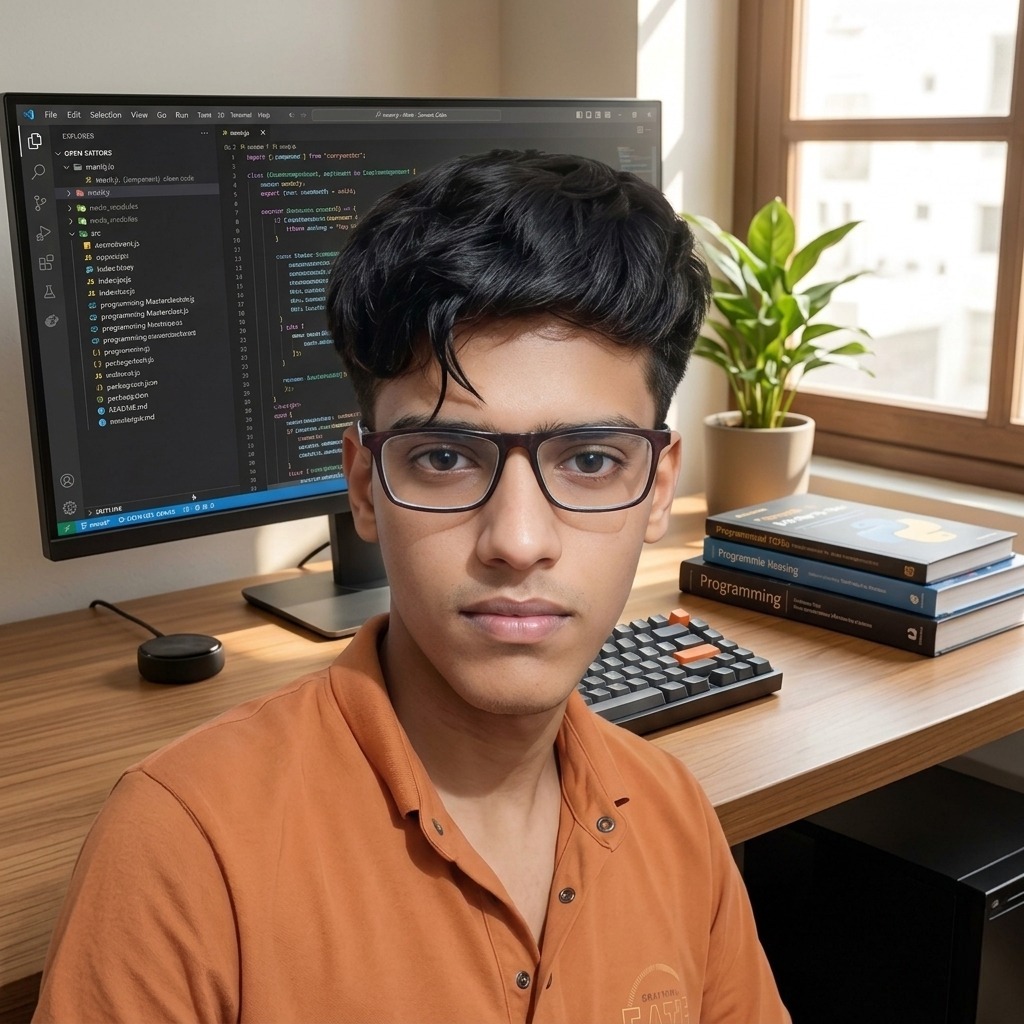
I’m Prashant Pandey, a Grade 11 student from Janakpur, Dhanusha, Nepal. I’m curious about how technology works, how ideas can become real projects, and what I can learn by trying to make something myself.
I’m not a software professional, engineering-college student, or graduate. I’m a school student learning independently. For roughly three years, I’ve been exploring programming and making projects with help from AI coding tools, often through an iterative style people call vibe coding. I want this profile to be clear about that: AI tools help me write and revise code; the ideas, goals, product direction, and choices about what to explore come from me.
How I learn and make things
I learn by following questions. An idea leads me to research, try a tool, make a prototype, see what works, and decide what I want to understand next. I have experimented with many projects over the past few years. Some are small, some unfinished, and some have grown into longer projects. I share the process because the experiments and lessons are part of the work, too.
Using AI coding tools has let me explore projects that might otherwise feel out of reach as a school student working on my own. It also gives me plenty to learn: how to describe a problem, assess generated code, make design decisions, notice limitations, and keep iterating toward something useful. I’m still developing my technical skills, and I try to be open about what I know and what I’m learning.
FlowWrite
FlowWrite is one of my main personal projects: a writing application shaped around my own ideas about how a flexible writing space could work. I’ve used Python, Node.js, and AI coding tools while developing it. The project explores rich documents, formatting, images, links, tables, code, saving, search, and exporting work to HTML or PDF.
Making FlowWrite has given me a way to explore how an application fits together—from the writing canvas and document structure to saving, importing, and exporting. I’m continuing to improve it and learn from the decisions, prototypes, and problems along the way. You can explore FlowWrite or read the FlowWrite platform guide.
What I’m curious about
My interests keep changing, but I often return to questions about how systems work. I’m exploring programming, web projects, artificial intelligence, computer vision, local and efficient AI, operating systems, computer architecture, C, assembly, and how computers start and run software. I’m also interested in mathematics, physics, filmmaking, and creative technology.
I’m learning these subjects; I don’t claim to be an expert in them. I enjoy moving between a practical project and a bigger question, and I’m happy to label an idea as speculation when I haven’t established that it’s true.
Ideas, writing, and learning in public
Not every thought needs to become a product or a polished technical article. This website also gives me room for free writing: observations, questions, personal reflections, ideas, experiments, and topics I’m still working through. Sometimes writing helps me explain what I tried. Sometimes it helps me figure out what I think.
I want the site to show a real learning journey rather than present a finished expert identity. Projects may change, experiments may fail, and my interests may lead somewhere I can’t predict yet. I’ll update the site as I learn and make more things.
What I hope to do next
I want to become more capable at understanding unfamiliar problems and turning my ideas into useful projects. I’m interested in learning more about computer science and AI, getting closer to the systems underneath everyday software, strengthening my foundations in mathematics and science, and exploring creative work beyond the screen. I haven’t chosen one fixed career path, and I’m still at school; these are directions I hope to explore over time.
I welcome thoughtful feedback, mentorship, student-friendly opportunities, and collaborations that give me a chance to learn and contribute. If something I’ve made interests you, or you have a project, question, or opportunity you think I should see, get in touch.
I don’t just want to know that something works. I want to understand why—and when I can’t find what I want to learn, I like trying to make it.